This article describes a general professional workflow and is not engineering advice for any specific building. Statutory thresholds and deadlines vary by jurisdiction and are amended periodically — always confirm current requirements with a licensed professional and the governing statute for the building's location
When a building's structure fails catastrophically, the post-mortem almost always reveals the same uncomfortable truth: the warning signs were visible for years, and somebody was responsible for looking. Milestone structural inspections exist to make that "looking" systematic, documented, and legally accountable. But while plenty has been written about why these inspections are now mandated for aging multi-story residential buildings, almost nobody publishes the part engineers actually need: the field workflow — what you record, how you decide whether deterioration is "substantial," and how raw observations become a sealed, compliant report.
This guide fills that gap. It walks through the milestone inspection process from the first walk-around to the final signed deliverable, and shows where a structured documentation system turns a chaotic, photo-heavy site visit into a defensible report. Whether you are an inspector scaling across a portfolio of buildings or a condo board trying to understand what your engineer is actually doing, this is the operational picture. The phrase milestone inspection workflow describes a repeatable, deadline-driven process — and repeatable is exactly what keeps you and your client out of trouble.
Table of Contents
What a Milestone Inspection Actually Is
Phase 1: The Visual Inspection Workflow
Defining "Substantial Structural Deterioration"
Phase 2: Scoping the Investigation
The Structural Integrity Reserve Study (SIRS)
Anatomy of a Compliant Report
Standardizing Across a Portfolio
Frequently Asked Questions
Conclusion
1. What a Milestone Inspection Actually Is
The milestone inspection process flows from a Phase 1 visual assessment to a substantial-deterioration determination, which gates entry into Phase 2 targeted investigation.
A milestone inspection is a phased structural assessment of a building's load-bearing and life-safety systems, triggered when a building reaches a defined age and/or height. The trigger thresholds, the recurring cycle, and the precise definitions are set by statute and vary by jurisdiction. In Florida, under Florida Statute $ 553.899 (enacted as part of SB 4-D following the Champlain Towers South collapse), a condominium or cooperative building three stories or more in height must complete its first milestone inspection by December 31 of the year it reaches 30 years of age — or 25 years if located within three miles of the coastline — measured from the date the certificate of occupancy was issued, and every 10 years thereafter. New York City runs a separate, facade-specific regime under the Facade Inspection Safety Program (FISP, the successor to "Local Law 11"): buildings six stories or taller must undergo a "critical examination" of the exterior walls every five years, performed by a Qualified Exterior Wall Inspector (QEWI); the current cycle (Cycle 10) runs from February 2025 through February 2030. Miami-Dade and Broward Counties historically operated their own 40-year (then every-10-year) structural and electrical recertification programs, which have since been aligned with the statewide 30-year / 25-year-coastal thresholds under § 553.899. Because these thresholds and cycles have been amended more than once since the post-Surfside wave of legislation, the responsible move is always to read the current statute text for the building's location rather than rely on a figure cited in a blog post.
What doesn't vary much is the underlying engineering logic, and that is what this article focuses on. A milestone inspection is structured in two phases:
- Phase 1 — Visual assessment. A licensed engineer or architect visually examines the building's primary structural systems and life-safety elements to determine whether there are signs of substantial structural deterioration.
- Phase 2 — Targeted investigation. Triggered only if Phase 1 identifies substantial deterioration. It uses destructive and non-destructive testing to quantify the damage and define repairs.
The deliverable is a signed and sealed report submitted to the local authority and to the building's governing body. The entire process is standardized, recurring, deadline-driven, document-heavy, and legally consequential — which is precisely why it rewards a disciplined, reusable workflow rather than an ad-hoc site visit.
Industry best practice: Treat the statute as the minimum scope, not the target. A milestone inspection that only checks the literal statutory boxes still leaves you exposed if a reasonable engineer would have looked further. Document your reasoning for what you inspected — and what you intentionally did not.
2. Phase 1: The Visual Inspection Workflow
Phase 1 is where most of the real engineering judgment lives, and where most documentation failures happen. A defensible Phase 1 is not "walk the building and take photos." It is a structured pass through every primary structural system, with each observation tied to a location, a date, and a severity assessment.
2.1 Build the inspection around systems, not rooms
Organize your field record by structural system, because that is how deterioration mechanisms cluster and how your report will eventually read:
- Foundation and below-grade elements — settlement cracking, water intrusion, exposed or corroding reinforcement, soil movement evidence.
- Primary vertical structure — columns, load-bearing walls, shear walls: cracking patterns, spalling, corrosion staining, out-of-plumb conditions.
- Horizontal structure — slabs, beams, post-tensioned elements: deflection, cracking, delamination (sound it out with a chain drag or hammer), efflorescence.
- Balconies, walkways, and cantilevers — these are high-risk in coastal and older buildings because of chloride-driven rebar corrosion; check rebar cover, spalling, railing embedment.
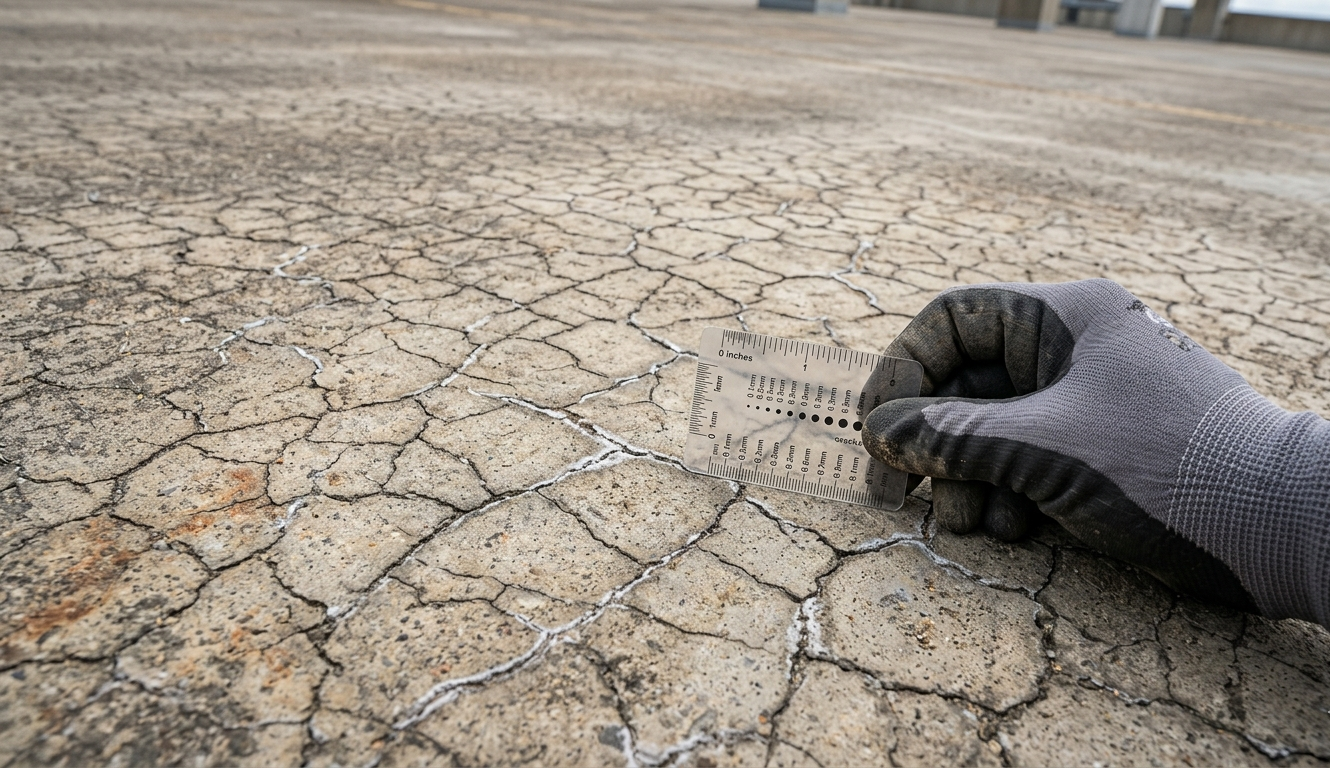
- Parking structures — among the most aggressive exposure environments due to de-icing salts and vehicle-tracked chlorides; inspect decks, beams, joints, and drainage.
- Building envelope and waterproofing — façade, roof, joints, and sealants, because water is the transport mechanism behind most structural deterioration.
2.2 Record context, not just damage
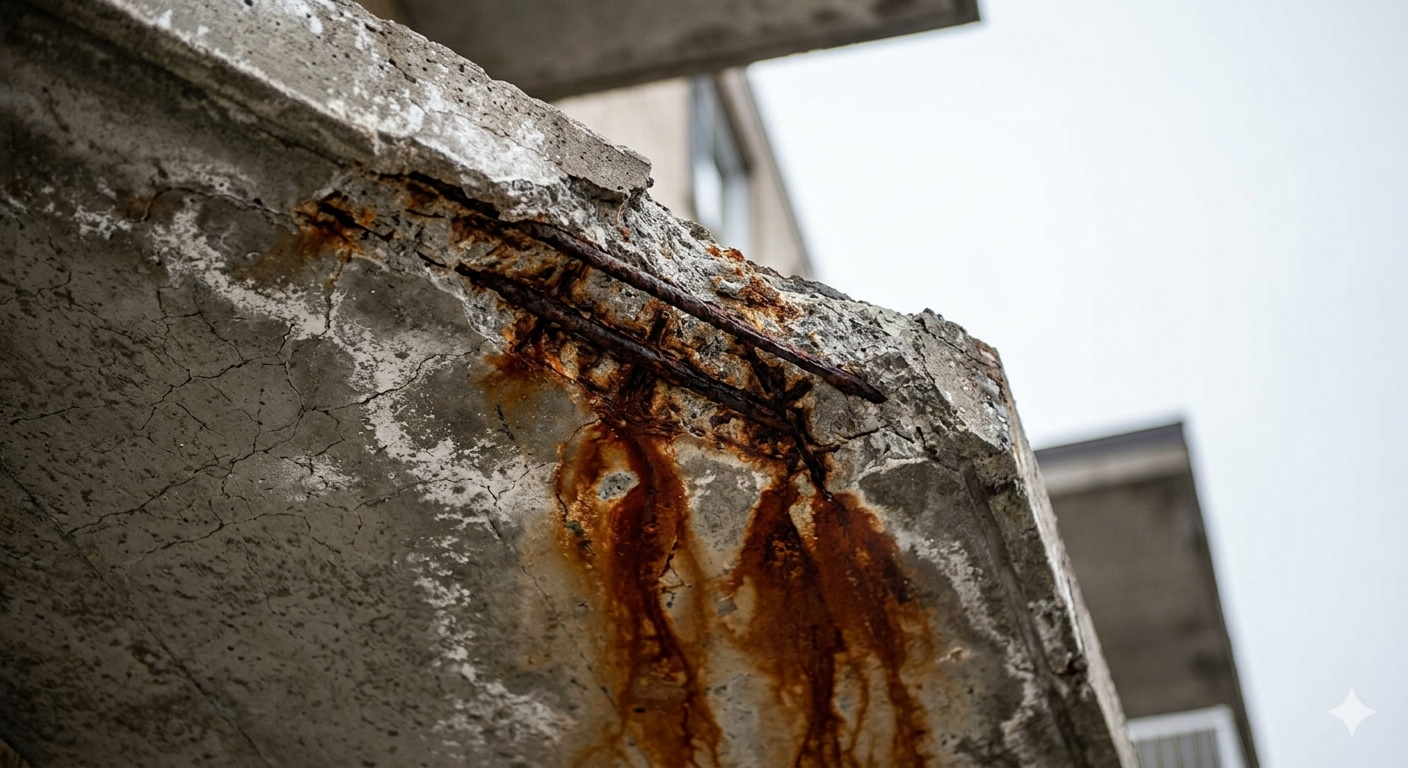
Spalling and rust staining on a balcony soffit — a high-risk finding that combines crack width, exposure context, and visible corrosion to push a building toward Phase 2.
The single most valuable habit in Phase 1 is capturing the context that the eventual repair design — or a Phase 2 investigation — will need. For every flagged element, record location (gridline or unit reference), a measurement (crack width, spall depth, area affected), an exposure note (interior, exterior, splash zone, below grade), and at least one scaled photograph with the location embedded.
Practical example: A 0.4 mm crack on an interior partition and a 0.4 mm crack on a coastal balcony soffit are the same width but not the same problem. The first is likely cosmetic; the second, combined with rust staining and a hollow sound on chain-drag, signals active rebar corrosion and almost certainly pushes the building toward Phase 2. The crack width alone tells you nothing — the context does.
This is exactly where a structured inspection platform earns its place. When every observation is logged against a fixed component checklist with mandatory location, severity, and photo fields, the inspector cannot accidentally leave a gap, and the data is already in report-ready form before they leave the site.
3. Defining "Substantial Structural Deterioration"
The hinge of the entire process is a single determination: does the building exhibit substantial structural deterioration? If yes, the building proceeds to Phase 2 and the stakes — and the engineer's liability — rise sharply. The precise statutory definition of that term is jurisdiction-specific. Under Florida Statute $ 553.899, "substantial structural deterioration" means substantial structural distress or substantial structural weakness that negatively affects a building's general structural condition and integrity — and it explicitly excludes surface imperfections such as cracks, distortion, sagging, deflections, misalignment, signs of leakage, or peeling of finishes, unless the inspecting engineer or architect determines that those imperfections are themselves a sign of substantial structural deterioration. Other jurisdictions phrase the trigger differently, so confirm the current statutory wording for the building's location before relying on it.
From an engineering standpoint, the determination turns on whether the observed deterioration meaningfully affects the load-bearing capacity, durability, or life-safety function of a primary structural element — as opposed to cosmetic or surface-level distress. Hairline shrinkage cracking in a non-structural finish is not substantial deterioration. Section loss in a corroding column, delamination over a balcony, or active spalling exposing reinforcement very likely is.
Industry best practice: Write the rationale for your substantial-deterioration determination into the report, not just the conclusion. "No substantial structural deterioration observed" is far weaker than "No substantial structural deterioration observed; isolated shrinkage cracking ≤0.3 mm in non-structural finishes, no section loss, no active corrosion, no delamination on chain-drag survey of representative slab areas." The second version is what protects you if the building is challenged later.
Because this determination is a professional engineering judgment about a specific structure, it must be made by the licensed professional of record based on site-specific conditions. No checklist, article, or software can make it for them.
4. Phase 2: Scoping the Investigation
When Phase 1 flags substantial deterioration, Phase 2 moves from "is there a problem?" to "how bad, how far, and what does it take to fix?" The goal is to quantify the damage with enough confidence to design a repair, and that means selecting the right mix of testing.
4.1 Common Phase 2 methods
- Non-destructive testing (NDT): cover meter and half-cell potential surveys to map active corrosion; ground-penetrating radar (GPR) to locate reinforcement and detect delamination; impact-echo or ultrasonic methods for internal flaws.
- Partially destructive / sampling: concrete cores for compressive strength, carbonation depth (phenolphthalein), and chloride profiling; localized demolition to expose and measure reinforcement section loss.
- Material and durability testing: petrographic examination where the deterioration mechanism itself is in question (for example, distinguishing chemical attack from chloride-induced corrosion).
Practical example: A parking structure shows widespread map cracking and rust staining. Phase 2 might combine a half-cell survey (to map where corrosion is active versus dormant), chloride profiling on cores (to see whether the chloride front has reached the steel), and carbonation testing. Together these tell you whether you are looking at a localized repair or a structure-wide durability problem — a distinction worth potentially millions in repair scope.
The selection of methods is itself an engineering decision driven by what Phase 1 found. A structured Phase 1 record makes Phase 2 scoping faster and cheaper, because the investigator already knows exactly which elements, locations, and mechanisms to target instead of starting from a blank page.
For more on differentiating deterioration mechanisms before scoping Phase 2 testing, see our companion guide: ASR vs. DEF vs. Sulfate Attack: How to Tell Map Cracking Apart in the Field.
5. The Structural Integrity Reserve Study (SIRS)
The eight SIRS component categories that must be inventoried alongside the milestone inspection's structural systems checklist.
If the milestone inspection answers "is the building safe today?", the Structural Integrity Reserve Study answers "can the association afford to keep it safe?" A SIRS is a financial-planning companion to the physical inspection, and it exists to prevent the failure mode where a building's deterioration is known but the money to fix it was never set aside.
In Florida, a SIRS must inventory eight specific components: the roof; load-bearing walls and other primary structural systems; fireproofing and fire protection systems; plumbing; electrical systems; waterproofing and exterior painting; windows and exterior doors; and any other item with a deferred-maintenance expense or replacement cost exceeding $ 25,000 whose failure to address would negatively affect any of the listed structural items. For each component it estimates remaining useful life and replacement cost, then calculates the reserve funding the association must hold. The SIRS generally runs on the same 10-year recurring cycle as the milestone inspection; the initial completion deadlines have been the subject of more than one legislative extension since the law was enacted, so confirm the current applicable deadline against the latest statute and any association-specific guidance before citing a date.
Industry best practice: Run the milestone inspection and the SIRS as one coordinated data-collection effort, not two disconnected visits. The component inventory the SIRS needs overlaps heavily with the systems the Phase 1 inspection already covers. Capturing both against a shared component checklist eliminates duplicate site visits and keeps the physical condition and the financial estimate consistent with each other.
This overlap is the strongest argument for a unified inspection workflow: the same structured field record that produces a defensible milestone report also populates the component inventory at the core of the reserve study.
6. Anatomy of a Compliant Report
A milestone report is a legal instrument, not just a technical summary. To be defensible and accepted by the authority, it generally must include:
- Identification and scope — building, date(s) of inspection, the licensed professional of record, and the statutory basis and scope of the inspection.
- Methodology — how the inspection was conducted, what was accessible, and any limitations (areas not inspected and why).
- Findings by system — organized, photo-documented observations tied to locations, with severity assessments.
- The substantial-deterioration determination — stated explicitly, with the engineering rationale behind it.
- Recommendations — required repairs, further investigation (Phase 2), and recommended timelines.
- Signature and seal — the licensed engineer's or architect's signature and professional seal.
Industry best practice: The limitations section is not boilerplate to skip — it is liability protection. Clearly stating what you could not access (an occupied unit, an obstructed crawl space, a concealed structural element) draws the line around what your determination covers. An undocumented limitation can later be read as an inspection failure.
The gap between a field full of photos and a sealed, structured report like this is exactly where most of an inspector's non-billable hours disappear. A platform that maps each statutory component to a field-record field, and assembles the findings into a compliant report template, collapses that gap — the report is largely written by the time the inspection is finished.
7. Standardizing Across a Portfolio
For an engineering firm inspecting dozens or hundreds of buildings against hard statutory deadlines, the real challenge is not any single inspection — it is consistency at scale. When ten different inspectors document ten buildings ten different ways, report quality becomes a lottery and review becomes a bottleneck.
Standardization solves this:
- A fixed component checklist ensures every inspection covers the same systems in the same order, so nothing is silently skipped.
- Mandatory fields (location, measurement, severity, photo) prevent the incomplete observations that trigger rework.
- Templated reports ensure every deliverable contains the legally required sections, regardless of who ran the inspection.
- A central record makes the recurring cycle manageable — you know which buildings are due, what last cycle found, and whether prior recommendations were acted on.
This is the product-led core of the whole discipline: milestone inspections are a structured, recurring, deadline-driven, document-heavy workflow, which is the exact category of work that purpose-built inspection and report-automation software is designed to absorb.
Frequently Asked Questions
What is the difference between a Phase 1 and a Phase 2 milestone inspection?
Phase 1 is a visual inspection by a licensed engineer or architect to determine whether substantial structural deterioration exists. Phase 2 happens only if Phase 1 finds such deterioration, and uses destructive and non-destructive testing to quantify the damage and define the repairs needed. Most buildings that are well maintained never proceed past Phase 1.
What counts as "substantial structural deterioration"?
In engineering terms, it is deterioration that meaningfully affects the load-bearing capacity, durability, or life-safety function of a primary structural element — not cosmetic surface distress. The precise legal definition varies by jurisdiction, so confirm the current statutory wording for the building's location. The determination must be made by the licensed professional of record based on site-specific conditions.
Is a milestone inspection the same as a reserve study?
No. A milestone inspection assesses the building's physical structural condition, while a Structural Integrity Reserve Study (SIRS) is a financial study estimating the remaining life and replacement cost of major components so the association can fund future repairs. They are complementary and are most efficient when conducted as a single coordinated effort.
Who is legally allowed to perform a milestone inspection?
Generally a licensed professional engineer or registered architect, as defined by the governing statute in the jurisdiction. Because the inspection results in a signed and sealed report submitted to a public authority, it is a regulated professional service and cannot be performed by an unlicensed inspector.
How often do these inspections need to be repeated?
Both milestone inspections and reserve studies operate on recurring cycles set by statute, and those cycles differ by jurisdiction and have been amended over time. Always confirm the current recurrence requirement and the next applicable deadline against the governing law rather than relying on a previously cited figure.
8. Conclusion
Milestone inspections and reserve studies share three lessons worth carrying into every site visit. First, the engineering value lives in the documentation — context-rich, location-tied observations are what make a substantial-deterioration determination defensible. Second, Phase 1 quality drives everything downstream: a disciplined visual record makes Phase 2 scoping and the reserve study faster, cheaper, and more consistent. Third, this work is inherently repeatable, which means standardization is not a nicety but the difference between a firm that scales cleanly and one that drowns in deadlines.
If your team is running milestone inspections or reserve studies across a portfolio, a structured inspection and report-automation platform turns that photo-heavy site visit into a compliant, sealed-ready report — and keeps your whole portfolio's recurring deadlines in one place. Explore how automated inspection reporting fits your milestone workflow, and read our related guides on documenting concrete deterioration in the field, including ASR vs. DEF vs. Sulfate Attack: How to Tell Map Cracking Apart in the Field and our balcony and parking-structure deterioration inspection guide.
Disclaimer: This article describes a general professional workflow and is not engineering advice for any specific building. Statutory thresholds, recurrence cycles, and deadlines vary by jurisdiction and are amended periodically. Always confirm current requirements with a licensed professional and the governing statute applicable to the building's location before relying on any figure in this article.