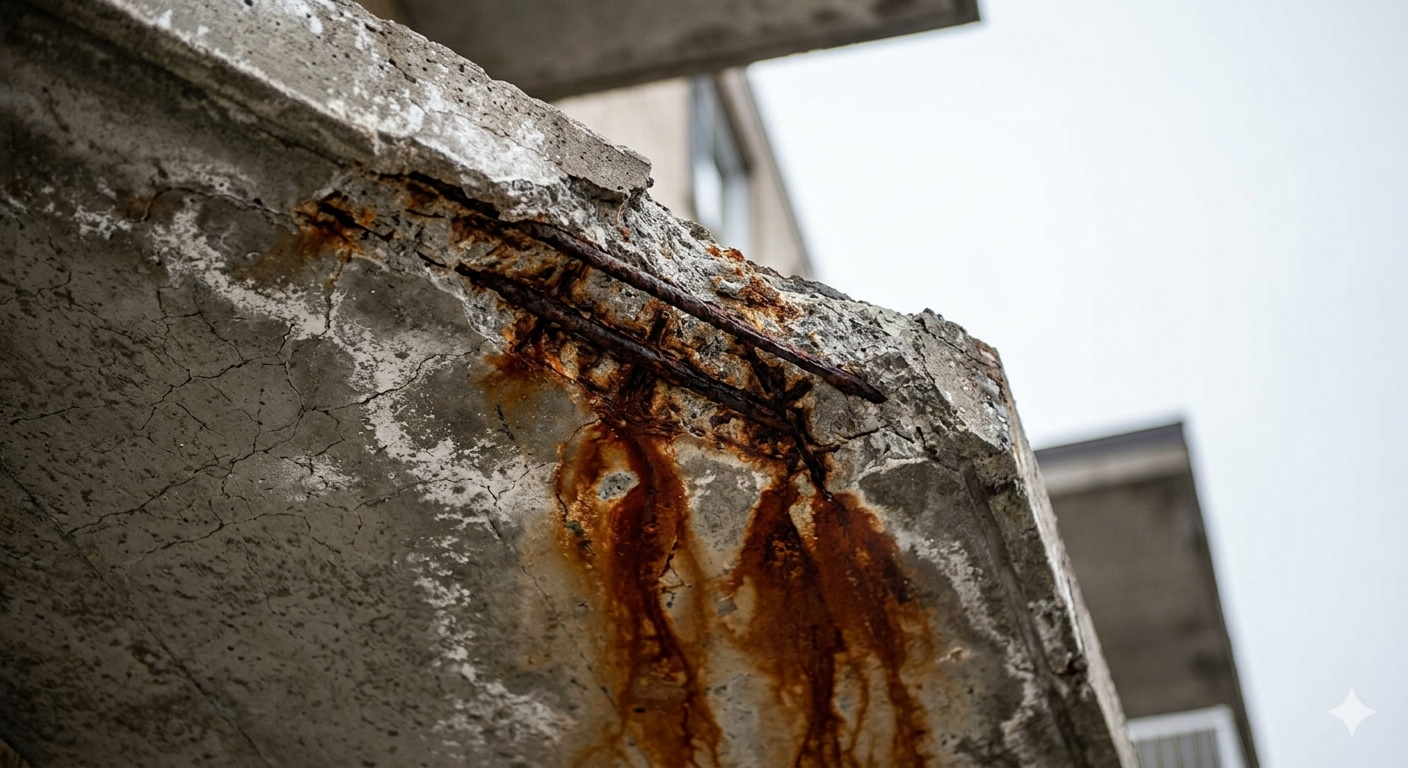
This is one of the most common and most misdiagnosed problems in concrete forensics, and most published guidance makes it worse by explaining each mechanism in isolation. This article does the opposite. It treats map cracking concrete causes as a single differential-diagnosis problem and gives you a framework to separate alkali-silica reaction (ASR), delayed ettringite formation (DEF), and external sulfate attack — using the context you can actually gather on site, before a core ever reaches a lab. You will leave with a comparison table, a triage logic, and a clear list of what to document so the lab can confirm the answer instead of starting from scratch.
Table of Contents
- Why Map Cracking Fools Everyone
- Mechanism 1: Alkali-Silica Reaction (ASR)
- Mechanism 2: Delayed Ettringite Formation (DEF)
- Mechanism 3: External Sulfate Attack
- The Differential Diagnosis: A Field Framework
- What to Document So the Lab Can Confirm
- Frequently Asked Questions
- Conclusion
1. Why Map Cracking Fools Everyone
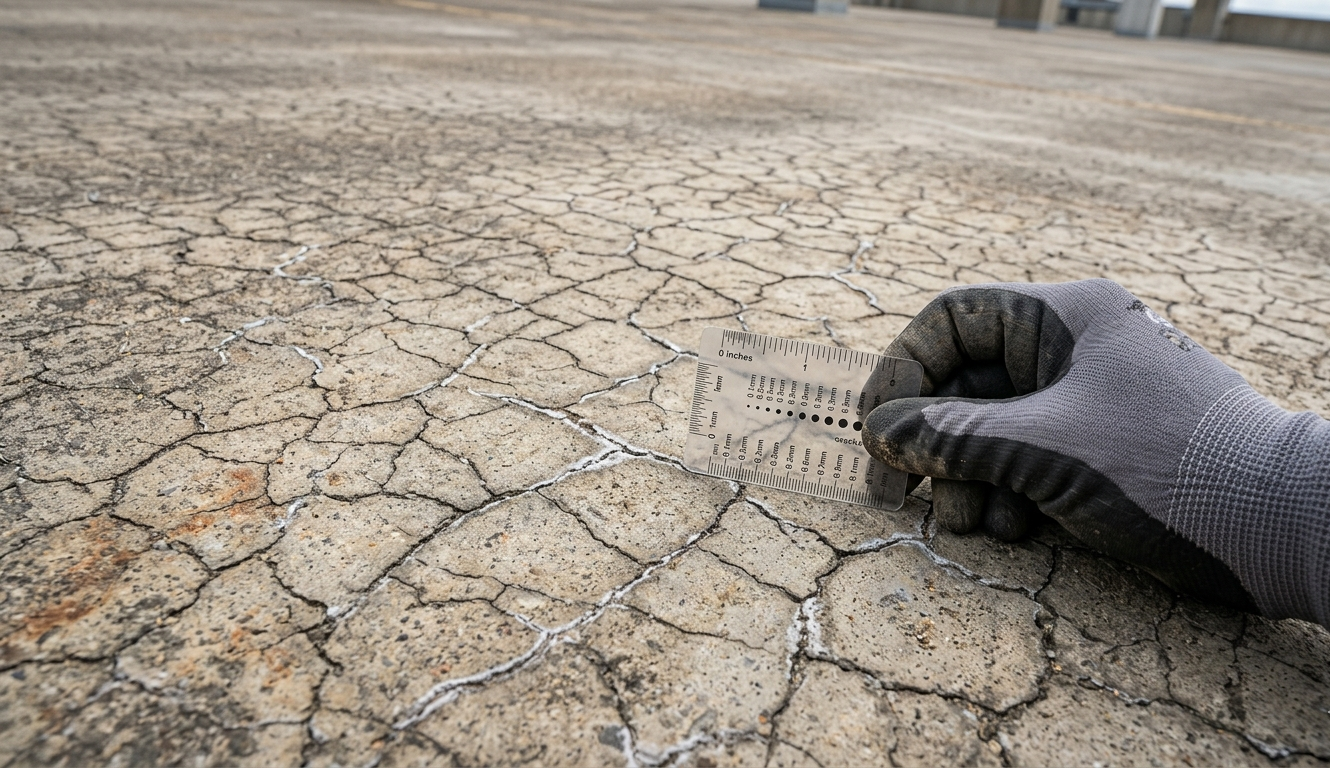
Map cracking on a concrete surface — the same visual symptom can be produced by ASR, DEF, or external sulfate attack, each requiring a different diagnosis and repair strategy.
All three mechanisms share a single underlying physics: they generate expansive internal pressure inside hardened concrete, and that internal expansion, restrained by the surrounding material, cracks the surface into the random, interconnected pattern we call map, pattern, or crazing cracking. Because the symptom — surface expansion cracking — is shared, the surface appearance alone cannot tell you the cause.
That is the core teaching point of this entire article: you cannot reliably diagnose these mechanisms by looking at the cracks. What separates them is not how they look but where the expansion comes from and what conditions produced it:
- ASR is an internal chemical reaction involving the aggregate.
- DEF is an internal sulfate reaction driven by the concrete's thermal history.
- External sulfate attack is an environmental attack advancing inward from the exposed surface.
The practical consequence is that diagnosis is a process of triage by context first — curing history, exposure environment, aggregate source, and age at onset — followed by laboratory confirmation. Get the context right on site and the lab work becomes confirmation rather than guesswork.
2. Mechanism 1: Alkali-Silica Reaction (ASR)
ASR is a chemical reaction between the alkali hydroxides in the cement pore solution and reactive (amorphous or poorly crystalline) silica found in certain aggregates. The reaction product is an alkali-silica gel that absorbs water and swells, generating internal tensile stresses that crack the concrete from within.
2.1 The three conditions ASR needs
ASR only proceeds when three ingredients are present simultaneously:
- Reactive silica in the aggregate (certain cherts, opaline rocks, strained quartz, some volcanic glasses).
- Sufficient alkalis, primarily from the cement but sometimes from external sources.
- Moisture — internal relative humidity generally needs to be high (the widely cited threshold is approximately 80% relative humidity or above).
Remove any one of the three and the reaction stalls — which is also why ASR-damaged elements that stay dry can appear stable while those exposed to water keep expanding.
2.2 Field signatures of ASR
Glassy, translucent alkali-silica gel exuding from map cracks — the most telling visual clue for ASR, distinct from the powdery white deposits of efflorescence.
- Map/pattern cracking, often with cracks that follow the more-restrained direction of the element.
- A glassy, whitish, or translucent gel exuding from cracks — the most telling visual clue, though it can be confused with efflorescence.
- Pop-outs over reactive aggregate particles.
- Under petrographic examination: reaction rims around aggregate particles and gel filling cracks and voids.
Industry best practice: Distinguish ASR gel from efflorescence on site before you commit to a hypothesis. Efflorescence (leached calcium carbonate or salts) is typically a powdery, chalky white deposit; ASR gel is glassy and can look resinous or jelly-like when fresh. They lead to opposite conclusions, so do not record "white deposit" without describing its texture.
3. Mechanism 2: Delayed Ettringite Formation (DEF)
DEF is an internal form of sulfate attack — the sulfate is already inside the concrete, not coming from the environment. It originates in the concrete's thermal history. When concrete experiences high temperatures at early age (commonly cited as above roughly 70 °C / 158 °F, a threshold reflected in the heat-curing temperature limits used by several concrete specifications), the ettringite that normally forms during early hydration is suppressed and its sulfate is held in the paste. Later, once the concrete has hardened and moisture is present, ettringite re-forms in the hardened paste and expands, cracking the concrete from within.
This thermal history is the key to spotting DEF risk. It is associated with:
- Mass concrete, where the heat of hydration in a large pour pushes core temperatures high.
- Steam-cured or heat-accelerated precast elements, where high curing temperatures are applied deliberately to speed production.
3.1 Why DEF is the hardest to isolate
DEF frequently coexists with ASR, and the two can act synergistically — both are internal, expansive, moisture-driven, and produce similar map cracking. Separating their relative contributions is genuinely difficult and is a job for an experienced petrographer examining the paste microstructure and ettringite morphology. The field clue that should raise DEF on your differential is a known history of high early-age or curing temperature, especially in precast or massive elements.
Practical example: A precast element cracks years after installation, in a moist but non-aggressive environment, with no reactive aggregate identified. Sulfate in the surrounding soil is low, ruling external attack unlikely. That combination — internal expansion, moisture, a steam-curing production history, and no external sulfate source — is the classic profile that moves DEF to the top of the list, pending petrographic confirmation.
4. Mechanism 3: External Sulfate Attack
External sulfate attack produces a damage gradient: deterioration is most severe at the exposed face in contact with sulfate-bearing soil or water and diminishes with depth.
External sulfate attack is the one mechanism whose source is outside the concrete. Sulfate ions in groundwater, soil, or seawater penetrate the concrete and react with the cement hydration products to form expansive ettringite and gypsum. The results are expansion, cracking, softening of the paste, and surface scaling or spalling.
4.1 The differentiator: a damage gradient from the surface
Because the sulfate front advances from the exposed face inward, external sulfate attack leaves a spatial signature the internal mechanisms do not:
- Damage is concentrated where the concrete contacts aggressive soil or water — below grade, at the waterline, in the splash zone.
- There is a gradient: the most severe deterioration is at the exposed surface and diminishes with depth.
- The paste often softens and loses cohesion, with surface scaling, unlike the more cohesive cracking of ASR/DEF.
4.2 The defenses are different too — which is why diagnosis matters
The protection strategies for each mechanism are not interchangeable, and this is the entire reason getting the diagnosis right has financial teeth:
- External sulfate attack: sulfate-resisting cement (low C3A / tricalcium aluminate content — in the ASTM system, ASTM C150 Type V cement, which limits C3A content to a maximum of 5%) and a low water-cement ratio to limit penetration.
- ASR: low-alkali cement, supplementary cementitious materials (SCMs such as fly ash or slag), and non-reactive aggregate.
- DEF: controlling curing and peak hydration temperature.
Apply the sulfate-attack defense to an ASR problem and you have spent money fixing the wrong thing while the gel keeps swelling.
5. The Differential Diagnosis: A Field FramewORK
5.1 The triage questions, in order
- What is the exposure environment? Is the damaged concrete in contact with sulfate-bearing soil, groundwater, or seawater, with a clear damage gradient from the exposed face? If yes, external sulfate attack rises to the top.
- What is the curing/thermal history? Was this mass concrete or steam-cured precast that saw high early temperatures? If yes, raise DEF.
- What is the aggregate source, and is there gel? Is the aggregate known or suspected to be reactive, and is glassy gel present? If yes, raise ASR.
- Confirm, don't conclude. Take cores for petrographic examination, which is the definitive method for all three.
Industry best practice: Do not let map cracking alone push you toward the mechanism you have seen most recently. Anchoring on a familiar diagnosis is the single most common cause of misdiagnosis in this space. Force yourself through all three triage questions every time, even when one answer seems obvious.
6. What to Document So the Lab Can Confirm
The most expensive mistake in this whole process is pulling a core, sending it to a petrographer, and getting back "insufficient context to determine mechanism" — because the field data the lab needed was never recorded. Definitive differentiation is done by petrographic examination of cores (thin-section and SEM), which reveals gel, ettringite morphology, reaction rims, and the damage gradient — the standard reference method is ASTM C856, Standard Practice for Petrographic Examination of Hardened Concrete. But the petrographer's job is dramatically faster and more conclusive when the field record gives them the context.
Capture all of the following on site, before sampling:
- Crack mapping: location, extent, pattern, and crack widths, with scaled photographs.
- Exposure environment: soil contact, water table, marine exposure, splash zone, interior vs. exterior — and whether damage shows a gradient from the exposed face.
- Curing and construction history: was it mass concrete or precast/steam-cured? Pour size and date if known.
- Aggregate source: the supplier or quarry, if obtainable, and any history of reactivity in the region.
- Age at onset: how old was the structure when cracking first appeared? (ASR and DEF often take years; external attack tracks exposure duration.)
- Associated signs: gel exudation, efflorescence, pop-outs, scaling, paste softening — described by texture, not just color.
This is precisely where structured field capture changes the economics of a forensic investigation. When every site record forces the inspector to log exposure, curing history, aggregate source, and age-at-onset against a fixed schema, the diagnostic context travels with the core to the lab automatically — and the petrographer confirms a hypothesis instead of building one from nothing.
For related field-documentation practices, see our guide on the milestone inspection field workflow, which covers how to build a structured Phase 1 record that feeds directly into Phase 2 scoping decisions like these.
Frequently Asked Questions
What is the difference between ASR and sulfate attack?
ASR (alkali-silica reaction) is an internal reaction between alkalis in the cement and reactive silica in the aggregate, producing an expansive gel from within the concrete. External sulfate attack comes from outside — sulfate in soil or water penetrates the concrete and forms expansive products near the exposed surface. The key practical difference is that ASR damage is distributed through moist concrete, while external sulfate attack shows a damage gradient strongest at the surface in contact with the aggressive environment.
Why do ASR, DEF, and sulfate attack all cause map cracking?
All three generate expansive internal pressure inside hardened concrete, and that restrained expansion cracks the surface into the same random, interconnected pattern. Because the symptom is shared, surface appearance alone cannot identify the cause — you have to look at the origin of the expansion and the surrounding context.
Can ASR and DEF occur at the same time?
Yes. ASR and DEF frequently coexist and can act synergistically, since both are internal, expansive, moisture-driven mechanisms that produce similar cracking. Separating their relative contributions is difficult and generally requires petrographic examination of the paste microstructure and ettringite morphology by an experienced petrographer.
How do you definitively confirm which mechanism is at work?
Petrographic examination of cores — thin-section microscopy and often SEM — is the definitive method. It reveals alkali-silica gel, reaction rims, ettringite morphology, and the spatial damage gradient that distinguish the mechanisms. Supporting tests such as aggregate reactivity and sulfate testing reinforce the diagnosis. Field context (exposure, curing history, aggregate source) is essential to interpret the results correctly.
Is map cracking always a structural problem?
Not necessarily. Shallow surface crazing from drying shrinkage can resemble map cracking but is often cosmetic, while ASR, DEF, and sulfate attack are progressive deterioration mechanisms that can threaten durability and capacity. Because the appearance overlaps, the safe approach is to investigate the cause rather than assume the cracking is superficial. A licensed engineer should assess any cracking on a load-bearing or life-safety element.
7. Conclusion
Three takeaways should travel with you to every site where map cracking appears. First, the crack pattern is the symptom, not the diagnosis — ASR, DEF, and external sulfate attack all produce expansive map cracking, so visual appearance alone will mislead you. Second, context is the differentiator: exposure environment points to external sulfate attack, thermal/curing history points to DEF, and reactive aggregate plus gel points to ASR — and petrographic examination confirms it. Third, getting it right has real money attached, because the defenses and repairs for these mechanisms are different and not interchangeable.
If your team investigates concrete deterioration in the field, capturing exposure, curing history, aggregate source, and crack mapping in a structured record is what lets the lab confirm the mechanism fast instead of guessing. Explore how a structured inspection platform keeps that diagnostic context attached to every core you pull, and read our companion guides on rebar corrosion and concrete durability for the related deterioration mechanisms, and our milestone inspection field workflow guide for how this fits into a broader inspection program.